
An abbot is the superior of an abbey. He guides the community of monks in prayer, work and fraternal life. As both a spiritual and administrative leader, he ensures that the monastic rule is observed. Our abbot is also the head of the Benedictine Congregation of Solesmes, which comprises no fewer than 31 abbeys and priories spread across three continents.
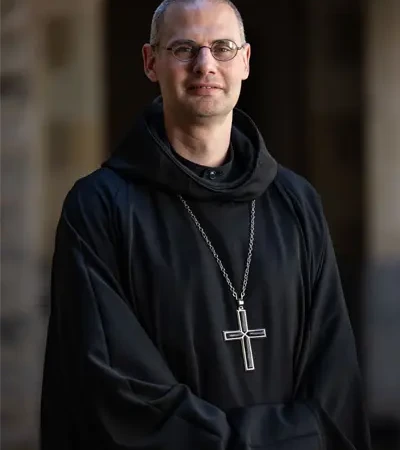
Dom Geoffroy Kemlin
Born on 24 March 1979, Dom Geoffroy Kemlin first entered Notre-Dame de Fontgombault, took his monastic vows at Solesmes on 8 September 2003, and was ordained a priest on 16 October 2010. Appointed prior in 2015, he was elected the seventh abbot of our monastery on 17 May 2022. Through his motto, taken from Psalm 132, ‘Fratres in unum’ – which might be translated as ‘brothers, together!’ – he shows us a path of fraternal and communal life that encourages us to walk united in the footsteps of Christ and Saint Benedict.
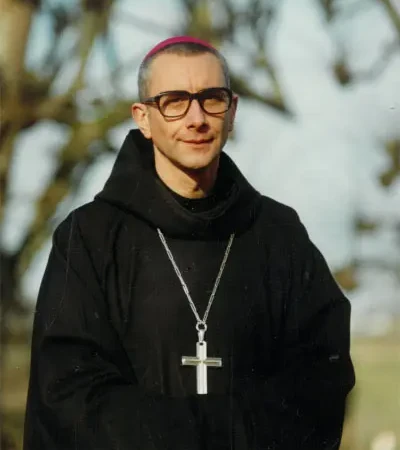
Dom Philippe Dupont
Born in 1946, Dom Dupont was elected abbot on 2 October 1992. His motto, ‘Quae sursum sunt sapite’ (‘Set your minds on things above’), taken from Saint Paul’s Letter to the Colossians (3:2), demonstrates his determination to uphold and strengthen the monastic and contemplative ideal of Solesmes. At his request, Bishop Jacques Faivre of Le Mans initiated the process for the beatification of Dom Guéranger on 21 December 2005.
In 1997, Dom Dupont undertook the foundation of a monastery in Lithuania, sending around ten of our brothers to the site at Palendriai, near the town of Kelmė. The consecration of the church of the new monastery took place on 7 June 2002.
As his health and advancing age began to take their toll, he deemed it appropriate to hand over the reins of the monastic community to a younger brother, resigning from his post on 19 April 2022.
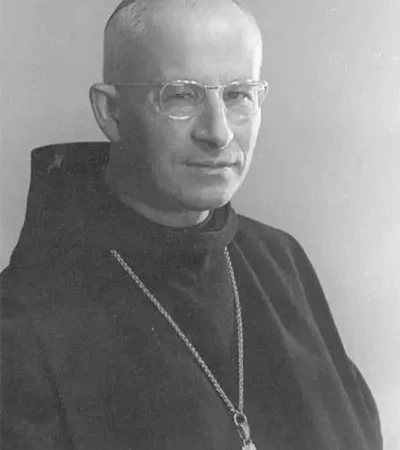
Dom Jean Prou
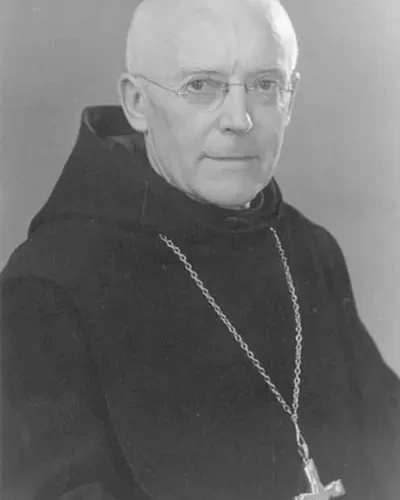
Dom Germain Cozien
Born in 1878, he was elected abbot in 1921. Believing that the political climate was favourable for a return to France, in a great act of faith and courage, he brought the community back to Solesmes the very following year, whilst leaving a group of monks behind at Quarr. He was committed to following the monastic tradition of his predecessors. His motto was *In vinculo pacis* – united in peace.
Back on the banks of the Sarthe, the Solesmes community saw a flood of vocations. After the necessary restoration work following this long absence, Dom Bellot, a monk and architect, built the library and the new cloister. This complex was ready in time for the congregation’s centenary, which was solemnly celebrated in 1937. Shortly afterwards, war broke out, leaving the monastery with only a few elderly monks and those exempt from military service. In 1940, three monks were killed at the front and several dozen were taken prisoner. Dom Cozien endured the hardships of the war and the occupation with remarkable composure. Once peace was restored, the prisoners returned and monastic life resumed with vigour.
In view of the growing number of monks, a decision was taken in 1948 to establish a new foundation in the buildings of the former Abbey of Fontgombault, on the banks of the Creuse. The end of his abbacy was marked by the construction in Solesmes of a new wing, situated to the east of the monastery, at right angles to the 19th-century building. Dom Cozien died on 18 May 1960, less than a year after stepping down from his position as abbot.
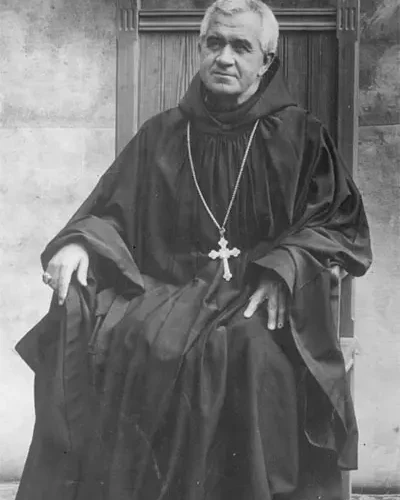
Dom Paul Delatte
Born in 1848, Dom Paul Delatte was prior of the monastery at the time of Dom Couturier’s death. The new abbot, elected on 9 November 1890, made it his first priority, following in the footsteps of his predecessors, to form souls seeking God. But, knowing only too well the necessity of enclosure for any serious monastic life, he first set about bringing the community back into his monastery; they had been scattered throughout the village as a result of the expulsions. This was achieved on 23 August 1895, and the bells rang out once more.
However, the building proved too small for a community that had continued to grow. Construction therefore began on a grand scale and at a rapid pace. On 21 March 1896, the foundation stone of the large building overlooking the River Sarthe was blessed. It was completed in 1898. At the same time, two offshoots set out to establish new foundations: one to Saint-Michel de Farnborough, near London, in 1895, and the other to Sainte-Anne de Kergonan, near Plouharnel in Brittany, in 1897.
These peaceful years came to an abrupt end with the Act of 1 July 1901. This Act, which concerned associations but was also directed against religious congregations, forced Dom Delatte and his monks into exile. It was with great emotion that they left Solesmes on 20 September 1901, heading for the freedom offered to them by England. Appuldurcombe Castle provided them with a refuge in the south of the Isle of Wight.The Juigné family bought back Solesmes Abbey, with the intention of returning it to the monks as soon as possible. In 1908, the community moved to the former Abbey of Quarr, in the north of the island. Dom Paul Bellot built a new monastery there.
The monks then took full advantage, in the silence and peace of their exile, of their abbot’s teaching. They all appreciated the qualities they found in him: a brilliant intellect, profound kindness combined with a delicate sensitivity, and above all a lively and steadfast faith. Dom Delatte left a deep and lasting mark on our community. Some of his teachings were published during his lifetime: the Commentary on the Rule of Saint Benedict, as well as commentaries on Holy Scripture: the Gospel of Our Lord Jesus Christ and the Epistles of Saint Paul. Dom Delatte also published a biography of Dom Guéranger which remains an authoritative work to this day.
He resigned from his post in 1921 and died in 1937 at Solesmes. His biography, published by one of his dearest disciples, Dom Augustin Savaton (1878–1965), abbot of Saint-Paul-de-Wisques from 1928 to 1960, is still available from our publishing house.
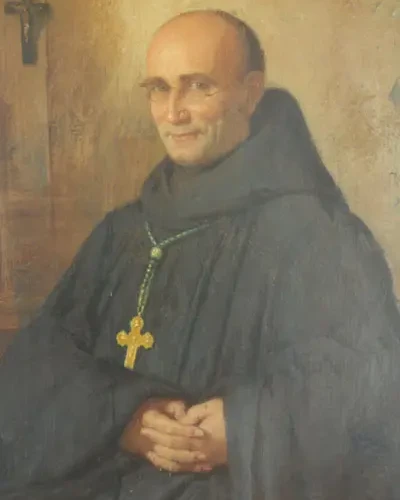
Dom Charles Couturier
Born in 1817, he was prior of our monastery—that is to say, second in command to the Father Abbot—at the time of Dom Guéranger’s death. He was elected to succeed him on 11 February 1875. The abbacy of this good and prudent man began under the best of auspices, in a monastery solely concerned with building upon its paternal heritage. From 1879 onwards, however, the French government embarked on a resolutely anticlerical policy. And on 6 November 1880, the monks of Solesmes were expelled from their monastery by the gendarmes.
For some fifteen years, the monks were forced to live outside their own doors. The monks then took up residence in around twenty houses in the village or the surrounding area that had been made available to them. And services were celebrated at the parish church or at Sainte-Cécile. A great grace from God enabled them, despite living conditions so at odds with their vocation, to retain all their fervour. The ordeal strengthened the unity of their hearts, attracted vocations, and even encouraged new foundations: the monastery of Saint-Paul was established in 1889 in Wisques, near the monastery of Notre-Dame, a foundation of Sainte-Cécile. In 1890, a group of monks took over the monastery of Saint-Maur de Glanfeuil, in Anjou.
Dom Couturier passed away on 29 October 1890 in the house in the village of Solesmes that had served as his refuge. Yet this was so at odds with the motto he had chosen for himself: Consortia tecta! This phrase, taken from Virgil’s Georgics, where it referred to bees gathered in a single hive—depicted on his coat of arms—showed just how much the Father Abbot cherished nothing more than the unity of the community gathered under one roof.
His biography was published by Éditions de Solesmes in 2011, written by Dom Guy Frénod (1942–2018).
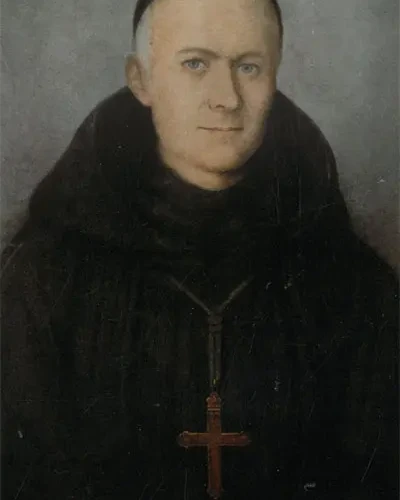
Dom Prosper Guéranger
On 11 July 1833, Dom Prosper Guéranger restored monastic life at Solesmes. He was born on 4 April 1805 in Sablé-sur-Sarthe, and for this reason was well acquainted with the small village of Solesmes.
After entering the seminary in Le Mans and being ordained a priest in 1827, he developed a passion for the history of the Church. His discovery of a past in which monasticism had flourished, and his exposure to the great works of the Maurists, awakened in him a certain desire for the monastic life. In 1831, upon learning of the imminent demolition of the priory of Solesmes, he conceived the idea of purchasing it so that he might live the Benedictine life there himself. With the help of a few friends and the encouragement of his bishop, he managed with great difficulty to raise enough money to rent the monastery and moved in with three companions on 11 July 1833. The small community had no money, no prestige to attract vocations, and, above all, no experience of monastic life. Their twenty-eight-year-old superior himself had only a theoretical understanding of it. The undertaking would have been an act of folly had it not been an act of faith. But the young prior, through his sound understanding of Benedictine matters, the liturgy and the spiritual life, was a living example to his monks.
In 1837, the Holy See recognised the community of Solesmes as authentically Benedictine and elevated the small priory to the status of an abbey, establishing it as the head of the French Congregation of the Order of Saint Benedict, which was created at the same time. A few days later, on 26 July, Dom Guéranger made his solemn profession before the abbot of Saint Paul Outside the Walls in Rome.
In 1866, with the help of Cécile Bruyère, Dom Guéranger founded the Abbey of Saint Cecilia at Solesmes, near the Abbey of Saint Peter, which was in turn to send out branches and give rise to the women’s branch of the Congregation of Solesmes.
Contemplation of the mystery of the Incarnation inspired his daily teaching, as well as his numerous writings. The liturgy, in particular, held his attention. He set out its spirituality for the Christian people in *The Liturgical Year*, his most famous work, which established him as a forerunner of the 20th-century liturgical movement. He also published *Liturgical Institutions*, which sets out the relationship between the liturgy, the faith and the unity of the Church. Through this work, Dom Guéranger contributed to the return of the dioceses of France to the Roman liturgy.
Dom Guéranger did indeed have a particular devotion to the papacy. His *Memoir on the Immaculate Conception* brought him to the attention of Pope Pius IX, who asked him to assist in the preparation of this Marian dogma, which was proclaimed on 8 December 1854. In 1870, during the First Vatican Council, he set out in *La Monarchie pontificale* the evidence from tradition in favour of the infallibility of the Roman Pontiff.
His devotion to the Sacred Heart was very deep. He regarded it as the best remedy against Jansenism. This was one of the reasons why he also took an interest in Saint Gertrude and the mystical writers.
As early as 1862, Dom Guéranger took the initiative to send several of his disciples to research the sources of the Church’s liturgical chant, thereby setting our monastery on a path that would lead to the restoration of Gregorian chant and the publication of its repertoire.
He died on 30 January 1875, aged 69. He is buried in the crypt of our abbey church, whilst his heart rests in the sanctuary of the Church of Saint Cecilia in Solesmes.
Several biographies of Dom Guéranger have been written to shed light on his life and work. His cause for beatification, opened in XXXX, is currently under investigation by the Bishop of Mans.
Case for the Beatification of Dom Prosper Guéranger
God our Father, your servant Dom Prosper Guéranger, Abbot of Solesmes, guided by the Holy Spirit, enabled a multitude of the faithful to rediscover the meaning of the liturgy, the source of the true Christian spirit. May his devotion to the Holy Church and his filial love for the Immaculate Virgin, drawn from the mystery of the Incarnate Word, be a light for Christians of our time. Grant us, O Lord, the favour we ask through his intercession, so that his holiness may be recognised by all and that the Church may allow us, as soon as possible, to invoke him as one of your blessed and your saints. Through Jesus Christ, our Lord. Amen.