‘He who loves sings,’ said Saint Augustine in one of his sermons. Praise of God naturally takes the form of song. It is thus expressed through our whole being, body and soul alike. For over a thousand years, the Roman Church has given form to its praise through Gregorian chant, to the extent that it has become its distinctive form of singing. Composed mainly from verses of the Bible in its Latin version, it serves as an artistic and musical commentary on the Scriptures. Far from being a relic of the past, Gregorian chant is a living expression of our prayer.
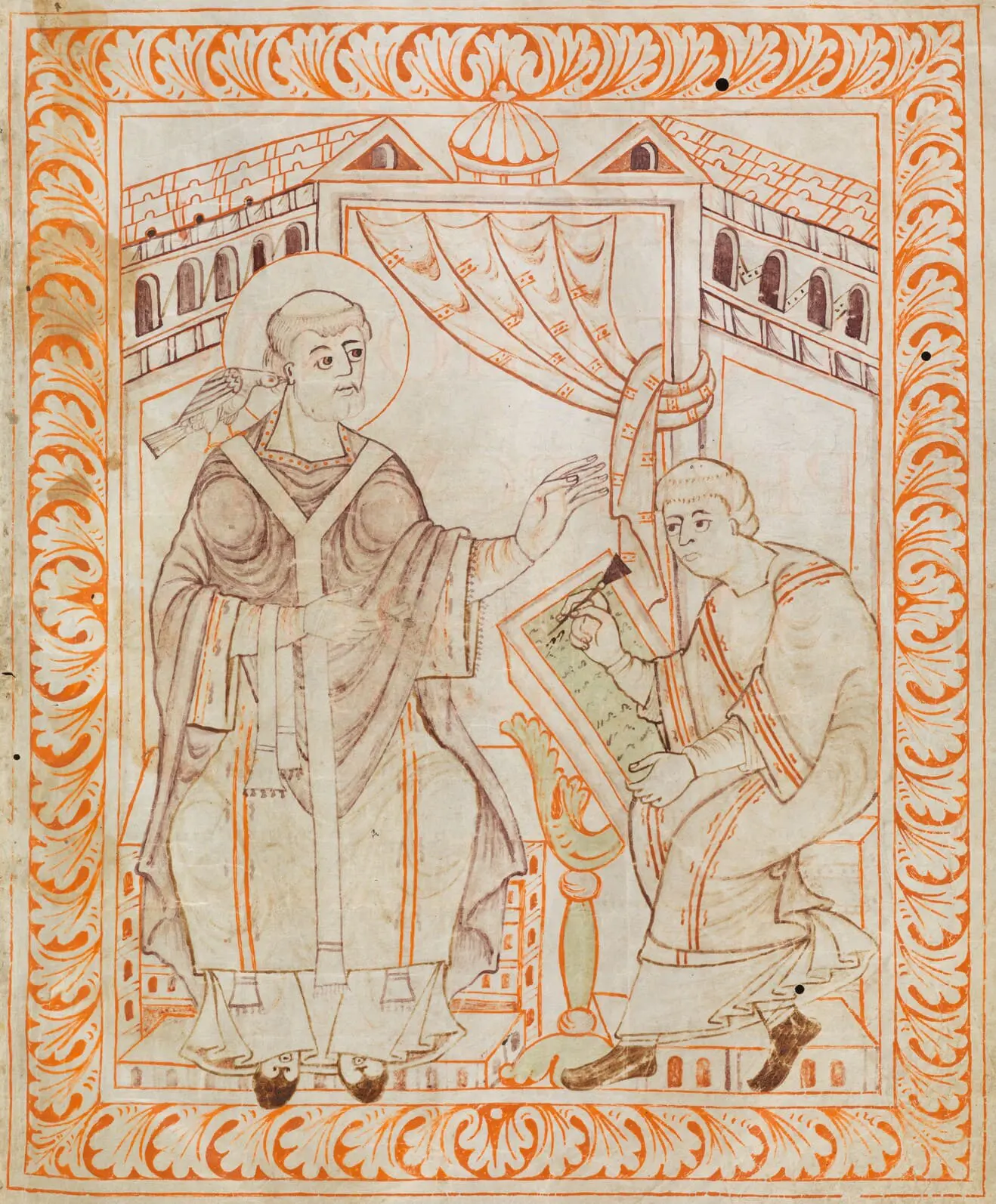
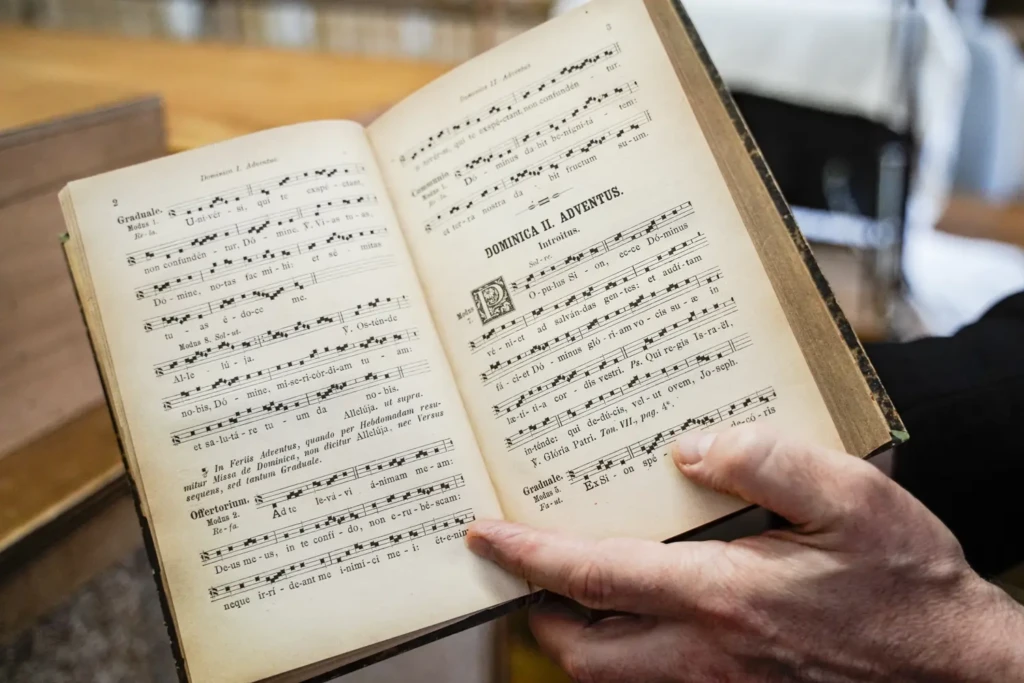
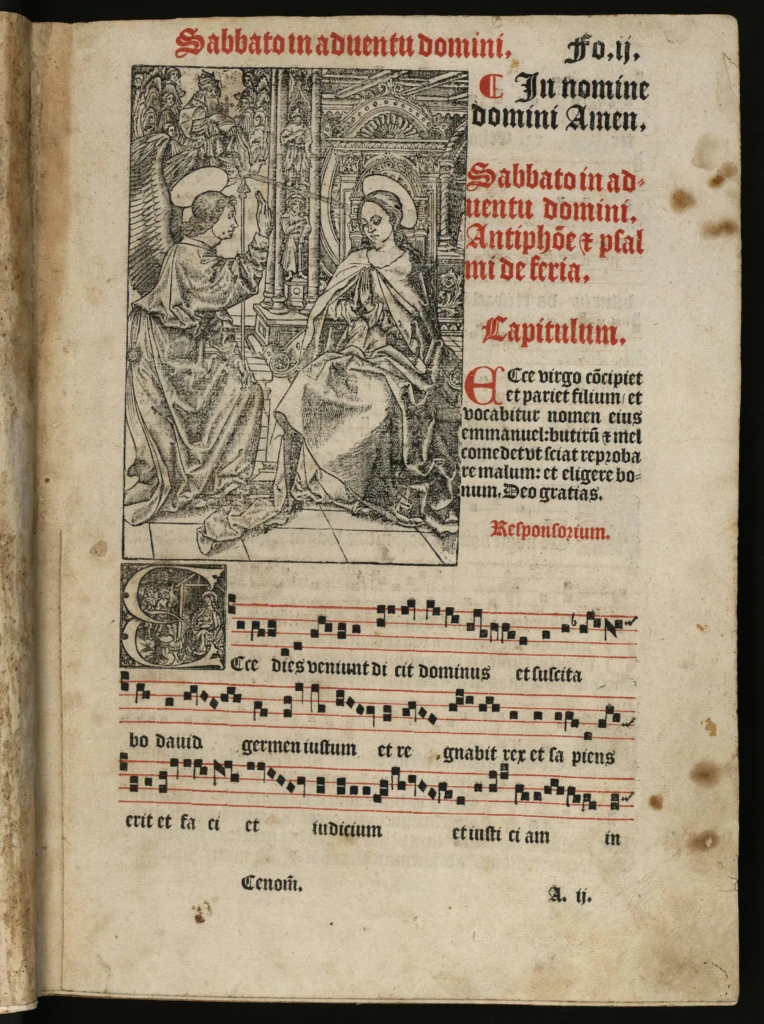
Gregorian chant is the distinctive chant of the liturgy of the Roman Catholic Church. Stemming from a long tradition, this musical repertoire—which the Second Vatican Council described as a ‘treasure of inestimable value’—is composed mainly of verses from the Latin version of the Bible, the Vulgate.
The history of Gregorian chant is complex: its origins and early development remain largely shrouded in obscurity. However, whilst its development was strongly influenced by Jewish and Greek musical cultures—particularly with regard to modal systems—Gregorian chant is first and foremost a product of the Latin culture of Antiquity and the early Middle Ages.
The Origins
In the West, around the 3rd and 4th centuries, a ‘traditional repertoire’ of ecclesiastical chants with still-simple melodies began to take shape, based on the recitatives of the liturgies of the early generations of Christians. Several regions developed their own local repertoires: Roman chant (in Rome), Beneventan (southern Italy), Milanese or Ambrosian (northern Italy), Hispanic (in Spain) and Gallican (in Gaul). From the 5th to the 7th century, the popes—notably Leo the Great, Gelasius and Gregory the Great (after whom Gregorian chant is named)—helped to organise the repertoire throughout the liturgical year.
In the mid-8th century, the Frankish kingdom of Pepin the Short adopted the Roman liturgy. Roman cantors crossed the Alps and the tradition was passed on orally, as the liturgical manuscripts they brought with them contained the texts of the chants but not their melodies. In northern Gaul, a new repertoire emerged, a successful fusion of Roman and Gallican chants.
Decline
Towards the end of the medieval period, with the emergence of polyphony—which distorted the phrase, its melody and, above all, its rhythm—Gregorian chant entered a period of gradual decline. Sidelined by the Renaissance and the Reformation, it underwent numerous attempts at restoration from the early 17th century onwards, in accordance with the principles of modern music. Disfigured and distorted, it lost its purity and its expressive power in the service of the Church’s prayer.
Restoration
It was the restorer of our monastery, Dom Prosper Guéranger (1805–1875), who initiated the movement to restore Gregorian chant based on the manuscripts; the research and reconstructions were aimed at publishing liturgical books intended for the monks’ chanting, and more broadly for the whole Church. This considerable undertaking, subsequently officially commissioned by the Church from the time of Pope Leo XIII onwards, is being carried out gradually by the Solesmes Musical Palaeography Workshop, which continues its work to this day so that, in accordance with the wish of the holy Pope Pius X (1903–1914), everyone may ‘pray amidst beauty’.
Gregorian chant is not, first and foremost, a subject of scientific and historical study. However important and necessary such research may be, it must not reduce it to a relic of the past, disregarding the living tradition of the Church. Indeed, the very nature of Gregorian chant places it at the very heart of the liturgy, the public prayer of the entire People of God. The Gregorian repertoire is therefore to be found in the liturgical books which the Church provides us with today. These books are the Gradual for the pieces of the Mass, and the Antiphonary for the entire Divine Office.
The chants of the Mass
The Gradual, the book containing the Gregorian chants sung during Mass, is composed of three main parts: the Proper of the Season and of the Saints, the Common of the Saints and the Ordinary.
The Proper contains the chants for each Sunday of the liturgical year (Advent, Lent, Eastertide, Ordinary Time, etc.), the feasts of the Lord and those of the saints. These ornate and elaborate chants are sung at various points during the celebration of Mass. The Introit [see below, Example 1] serves as the entrance chant for the celebration. The Gradual Psalm [2] and the Alleluia [3] are interspersed between the biblical readings proclaimed in the church. The Offertory chant [4] accompanies the preparation of the gifts—the bread and wine to be consecrated during the Eucharistic Prayer (Canon)—and the Communion chant [5], as its name suggests, the distribution of Communion to the faithful gathered in the church. On certain special occasions, other forms may be added, such as the ‘trait’ [6] during Lent or the famous sequences that lend their full splendour to certain feasts of the liturgical year (Victimæ paschali laudes [7], Veni Sancte Spiritus, Lauda Sion, Stabat Mater).
The Common of the Saints comprises pieces sung on the feasts of saints who do not have their own proper chants.
Alongside the chants of the Proper and the Common, the celebration of Mass includes chants that mark its various moments and whose texts are fixed. They are sung regardless of the day or feast. This is therefore known as the Ordinary of the Mass. These chants are the Kyrie [8], the Gloria [9], the Credo [10], the Sanctus [11] and the Agnus Dei [12].
Here are a few examples illustrating the different musical forms just mentioned: